
Hot Water Heating Element Replacement: A Laguna Hills, CA Homeowner Guide
An electric water heater that runs out fast or never gets hot usually has a failed element. This guide explains how to confirm it, what hard water does to elements and when to call a plumber.
Most electric tank water heaters have two heating elements, an upper one and a lower one. Each is a metal rod that glows hot when current passes through it. The upper element heats the top of the tank, then hands off to the lower element.
When one fails, the heater does not shut down. It keeps working, but badly, and that is why element trouble is easy to miss for weeks.
How to tell an element has failed
The symptoms depend on which element has quit. Knowing the pattern narrows the problem before anyone opens a panel.
| What you notice | Likely failed part | Why |
|---|---|---|
| No hot water at all | Upper element or upper thermostat | The top of the tank never heats, so nothing reaches the tap. |
| Hot water, but it runs out fast | Lower element | Only the upper third of the tank is heating. |
| Water is only lukewarm | One element or a thermostat | The unit cannot reach the set temperature. |
| Breaker keeps tripping | Shorted element | Current leaks to ground through damaged insulation. |
| Popping or sizzling | Scale on an element | Water boils on the crust of minerals. |
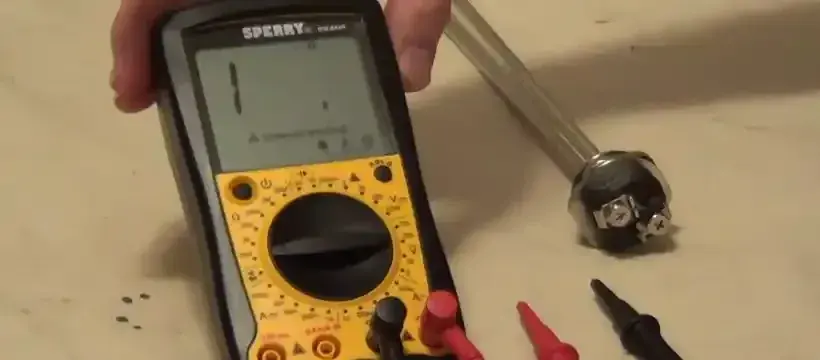
A sizzling sound is a hint that scale has coated the element. A multimeter can test continuity, but it should only be done with the power off at the breaker.
Why elements fail sooner in hard water
Elements sit inside the tank, surrounded by water. As hard water heats, calcium and magnesium leave solution and crust onto the hottest surface, which is the element. The crust insulates the metal, so the element runs hotter than it should and burns out.
Sediment also collects at the bottom of the tank and buries the lower element. That is why flushing a tank once a year matters more in hard water areas than in soft ones.
Repair or replace the whole heater
An element is a low cost part, and swapping it is a short job when the tank itself is sound. The decision to replace the heater comes from the tank, not the element.
- Repair when the tank is dry on the outside and under about a decade old.
- Replace when water is leaking from the shell, since that cannot be fixed.
- Replace when sediment is so heavy that flushing does not clear it.
- Weigh the cost when a second part fails in a short time on an old tank.
Our water heater repair page explains the repairs we make, and water heater replacement covers the tank swap.
Element or whole tank?Call the 24/7 line and we will diagnose the heater.
Call (949) 325-3122What a replacement involves
A plumber confirms which element failed, shuts off the power and the cold water, drains the tank below the element, and removes the element with a special socket. A new element and gasket go in, the tank refills completely and the power comes back on.
The tank must be full before the power is restored. An element powered in air burns out in seconds, which is a common DIY mistake.
Safety points that matter
Safety steps before touching an electric heater
- Switch off the breaker and confirm there is no power with a tester at the heater.
- Close the cold water valve so the tank can be drained safely.
- Open a hot tap in the house so air can enter as the tank drains.
- Expect very hot water in the tank. Let it cool or drain it into a safe place.
- Never restore power until water flows steadily from a hot tap.
Choosing the right replacement element
Elements come in different wattages, voltages and mounts. A 240 volt, 4,500 watt element is common, but many tanks use 3,800 or 5,500 watt parts. Match the data plate on the tank, because a higher wattage element on a circuit sized for less can trip the breaker.
Low watt density elements run cooler on the surface and collect less scale. In hard water they are often a better match than a standard element, and they cost only a little more.
Laguna Hills notes: hard water and code points
The El Toro Water District's 2026 water quality report lists hardness of about 236 mg/L for treated imported water, with a range of 191 to 280, and about 293 mg/L for water from the Baker plant. The USGS calls anything above 180 mg/L very hard, so elements in this area face the scale problem described above.
When a tank is open for service, the City of Laguna Hills handout on water heaters is a useful checklist. It calls for seismic straps in the upper and lower thirds of the tank, a temperature and pressure relief valve piped to a safe place and an expansion tank on closed systems. Ask the Building & Safety Division at (949) 707-2600 whether a given repair needs a permit.
Sources: El Toro Water District 2026 Water Quality Report (calendar 2025 data) and the USGS hardness scale. City of Laguna Hills water heater handout (2022 California Plumbing Code).
Keeping new elements alive
Flush the tank once a year to remove sediment. Check the anode rod, which sacrifices itself to protect the tank. In hard water, a water softener cuts the scale that attacks elements.
If you live in Laguna Niguel or Laguna Woods, the same advice applies, although local approvals differ.
Local questions, answered
How do I know whether the upper or lower element failed?
No hot water at all points to the upper element or thermostat. Hot water that runs out quickly points to the lower element. A technician tests both with a meter.
Is it safe to replace a heating element myself?
It can be done safely with the power off and the tank drained, but a mistake can burn out the new element or cause a shock. If you are unsure, a plumber can do it in one visit.
Does Laguna Hills water shorten element life?
The district's published hardness is very high by USGS standards, so scale is a real factor. Annual flushing and a softener reduce it.
Does an element replacement need a permit in Laguna Hills?
Replacing a heating element is a repair to a part. Ask the city's Building & Safety Division at (949) 707-2600 if you are unsure.
Element or whole tank?
Call the 24/7 line and we will diagnose the heater.